19th Century Court
IN THE CIRCUIT COURT OF THE UNITED STATES, WESTERN DISTRICT OF MISSOURI,
WESTERN DIVISION, AT KANSAS CITY.
The Reorganized Church of Jesus Christ of Latter Day Saints,
Complainant.
VS.
The Church of Christ at Independence, Missouri
Respondents.
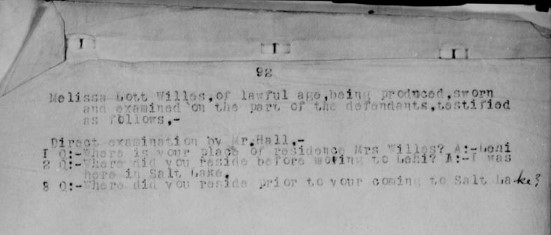
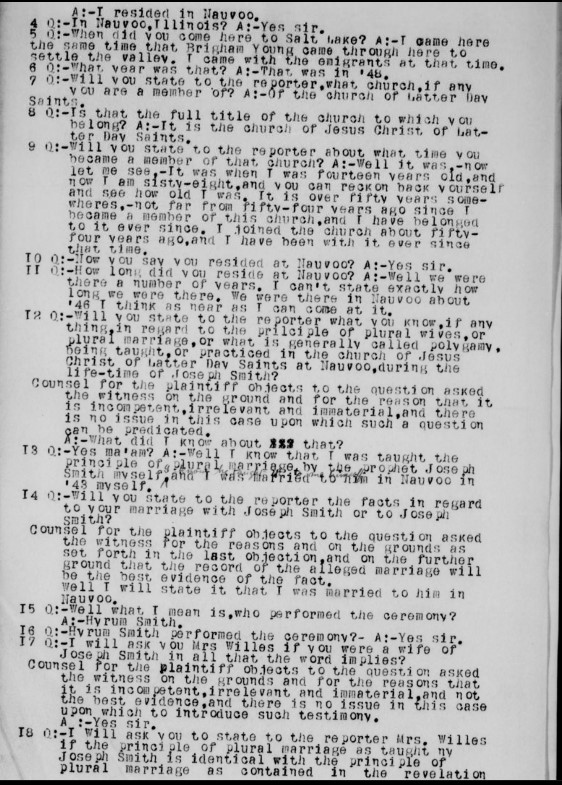
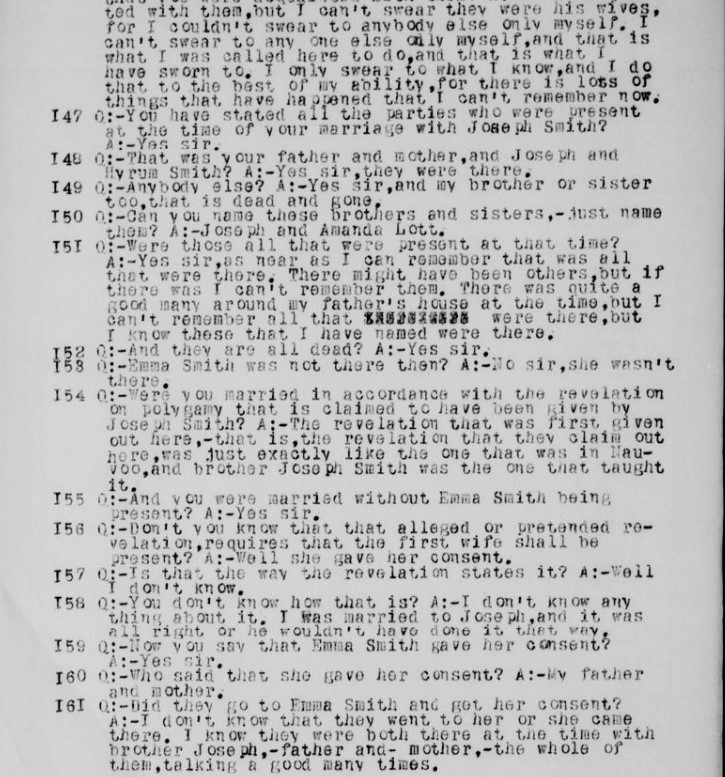
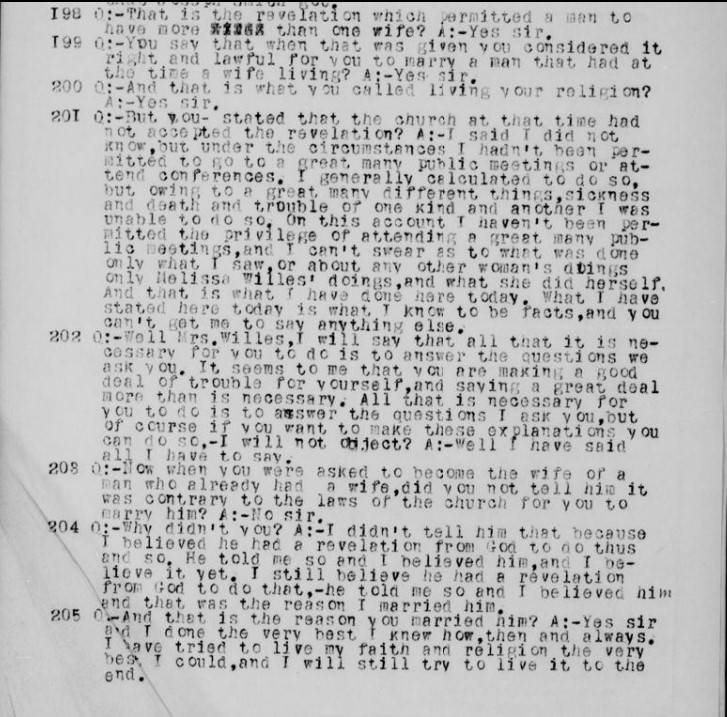
Melissa Lott Willes’s testimony in the Temple Lot case is considered one of the most important firsthand accounts about Joseph Smith’s practice of plural marriage.
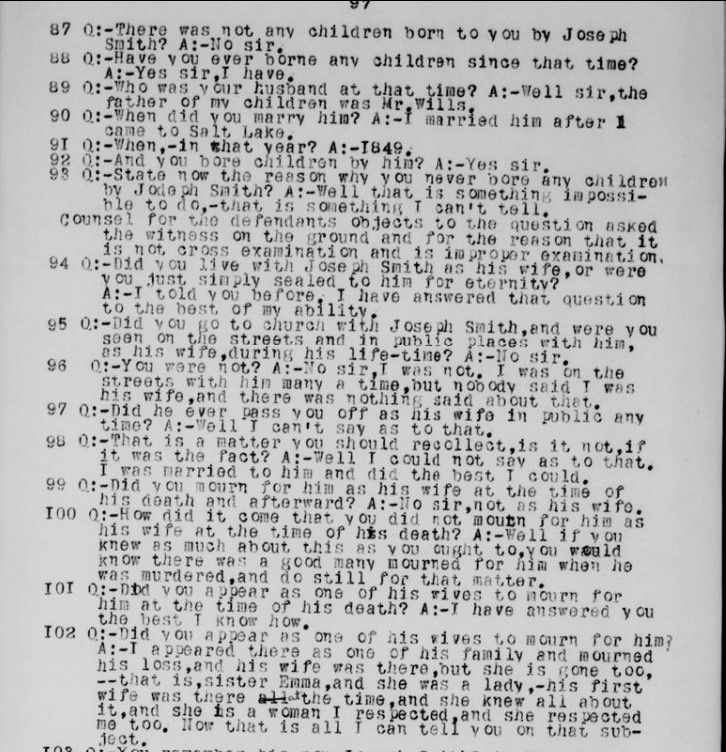
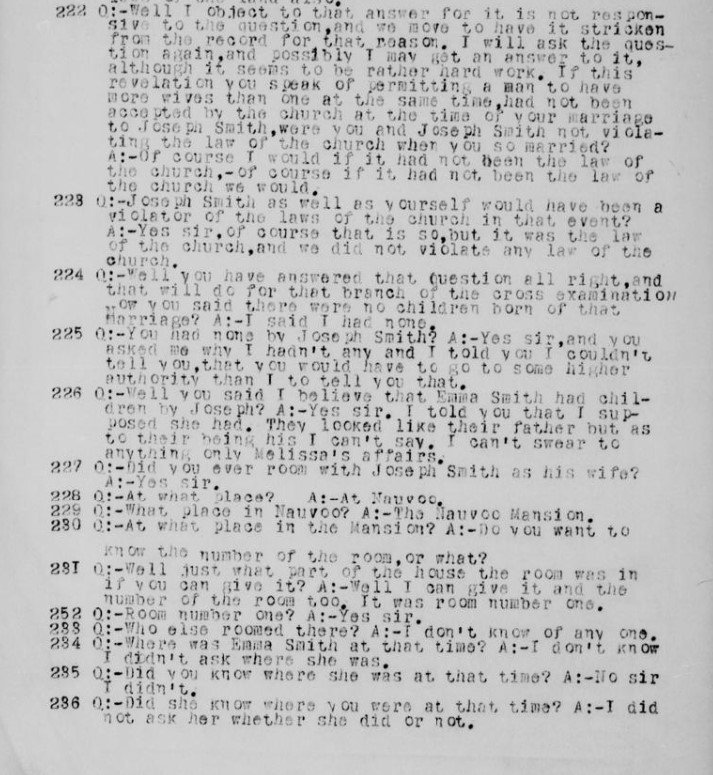
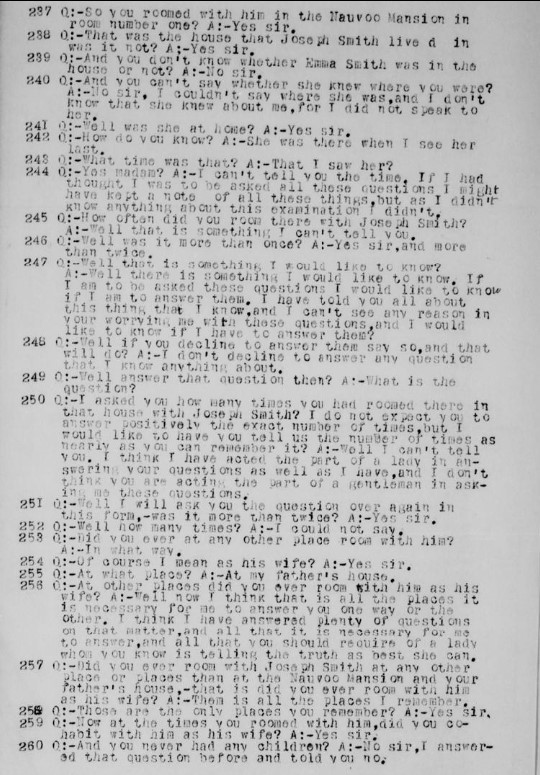
- Melissa explicitly claimed Joseph Smith married her plural-wife style. She stated under oath that Joseph Smith (age 37) proposed plural marriage to her, and at age 19, she became his wife “for time and eternity,” knowing that he was already married to Emma, but not seeming to know about any of the other wives. She testified that the marriage was performed secretly in Nauvoo and that she had sex with him multiple times in the Nauvoo mansion, not knowing if Emma knew anything about their relations. Beyond their sexual relationship, she did not seem to take on any other wife-like role or duties.
- She testified that she married her next husband after Joseph’s death, only for “time”, even though he was the father of their multiple children. She believes this dilemma will be worked out in heaven. This is one of the clearest firsthand sworn testimonies from a purported plural wife.
- Her testimony supports the idea that plural marriage was practiced privately and selectively in Nauvoo, not publicly taught to the church at large. This matches other Temple Lot testimonies where witnesses distinguished between public denials and private teachings. Wilford Woodruff similarly testified that Joseph Smith taught plural marriage privately to certain individuals, not openly to the church. Instead, it was actively denounced and denied to the church and to the world at that time.
- Melissa portrayed 39-yr old Emma Smith as conflicted, aware, and unaware at times concerning plural marriage and Joseph’s activities.
- The Utah church used witnesses like Melissa to prove continuity between Joseph Smith and the later Utah church.
Historians generally regard her testimony as significant evidence for Joseph Smith’s plural marriages. Even scholars who are cautious about late affidavits usually consider Melissa Lott Willes an important witness because:
- she gave sworn testimony in court,
- she was cross-examined,
- her account aligns with many other Nauvoo-era plural marriage testimonies,
- and she had little apparent incentive to fabricate a relationship that was socially controversial.
When you strip away theological framing and look specifically at the earliest Nauvoo polygamous relationships as they actually functioned, several troubling patterns emerge repeatedly in the testimony and documentary record:

* secrecy,
* unequal power,
* pressure tied to salvation,
* emotional manipulation,
* hidden relationships from Emma Smith and from the public,
* and asymmetrical obligations.

The women were often asked for:

* loyalty,
* secrecy,
* sexual availability,
* and spiritual trust.

But the men were not assuming what most people would recognize as ordinary marital responsibilities:

* public acknowledgment,
* equal companionship,
* financial support,
* stable household life,
* exclusivity,
* or long-term security.

That asymmetry is very difficult to ignore in the original sources.

Many of the Nauvoo plural wives did not receive:

* a public identity as wives,
* homes with Joseph,
* inheritance protections,
* social legitimacy,
* or the ability to openly claim the relationship.

Many remained socially vulnerable while Joseph retained religious authority and public status.

Several elements are especially troubling:

* women being told exaltation depended on acceptance,
* fathers or families being promised eternal blessings,
* young women approached privately,
* polyandrous relationships,
* secrecy from Emma,
* and the framing of refusal as resisting God.

Those are classic conditions where consent becomes ethically complicated because the religious leader controls both spiritual authority and social power.

* Kool-Aid interpreters emphasize revelation, sacrifice, and belief,
* while everyone else sees power imbalance, secrecy, and exploitation.

Joseph Smith had 30 to 40 secret wives.

At least 10 of his wives were teenage brides, under the age of 20.
14 years old: Helen Mar Kimball and Nancy M. Winchester.
16 years old: Fanny Alger and Flora Ann Woodworth.
17 to 19 years old: Several others, including Sarah Ann Whitney, Lucy Walker, Melissa Lott and Emily Dow Partridge.

12-13 of his wives were in their 20s.

Emma was about 30 years old at about the time Joseph started taking extra "wives".
Below are some excerpts of Melissa's testimony. Read the whole thing here by scrolling through using the arrows. https://catalog.churchofjesuschrist.org/assets/45f15236-fcd0-4963-8f8e-4f768865b6e1/0/68


Leave a Reply