Nancy Duffy Clark.
Journal of the Illinois State Historical Society, Vol. 11, No. 1, published in April 1918.
https://www.jstor.org/stable/40187036

Of all the towns and villages of Illinois, one of the truly
historic and certainly the most picturesque, is Nauvoo. It lies
just in the bend of the Mississippi, the ** Father of Waters.''
The only approach is across the river in a rickety ferry; or
by the perilous ''river road," poised half between the sky
and water, on the side of a cliff, or by the ''prairie road," a
drive of forty miles across the plains — the Grand Pre as the
Jesuit Fathers first called it.

So, if you haven't been drowned by the venerable ferry-
man, or plunged off the river road, or suffocated in your
long, hot drive over the prairie, you will see Nauvoo, a dream
village in the afternoon sunlight rise from the shore, creep-
ing up the hills crowned by rows of vineyards, rising tier by
tier to where at the back, the prairie rolls up and away.
Nauvoo seems cut off from the rest of the world, for there is
no connection by rail. The people have tried again and again
to build a trolley. The funds have been raised, the road
started, but always some obstacle has blocked the ill-fated
project; so that today one sees its ruins — a stone bridge,
moss-covered now, across a brook; a grade covered in grass
and wild flowers ; a bridge which needs only a floor to be com-
plete. The work seems to have ceased abruptly, the work-
men dropping their tools where they stood. Indeed the
whole town, lying in the embrace of the encircling river,
seems to sleep on and on, awaiting the kiss of its Prince
Charming, to be awakened to new life and usefulness.

It was in 1840 that the Mormons laid the foundations of
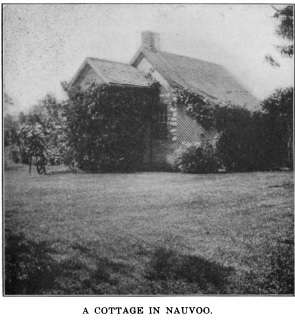
Nauvoo, or "Pleasant Land." The houses may be recog-
nized today by the uniformity of their style. They are se-
verely rectangular. There is a door directly in the middle,
at either side windows at regular intervals, a second row of
windows directly above, and a sloping roof guarded by

 A COTTAGE IN NAUVOO.

chimneys at each end — architecture which betrays their New
England origin. Their temple was an architectural anom-
aly ; the colunms, decorated with a crescent at the base, start-
ed out to be Doric, changed suddenly to Ionic, and just as sud-
denly changed into a nameless order finished by a grotesque
sun god surrounded by stars. The temple proper was built
on Venetian lines. Imagine all this finished with a Byzan-
tine cupola, and you see the marvelous structure which cost
the Mormons more than a million dollars. Yet this temple
was destined to be burned. Many wierd stories are whis-
pered around concerning the fire ; some say it was burned by
the Anti-Mormons ; some aver that a faction of the Mormons
themselves fired it rather than let the other faction sell it as
was their intention. Doric! Ionic! Venetian! Byzantine! It
never will be known whether they employed this conglom-
eration of style through ignorance or through their auda-
cious assumption that they, being the chosen children of God,
were entitled to the best of all ages and nations, even to the
moon, sun, and stars themselves. This delusion, carried out
in practical life, made the Mormons extremely disagreeable
in the locality. Did their neighbor have a good horse? It
rightfully belonged to the Chosen People, and one of them
would speedily become master of it. Had you a bam stored
with grain? God willed that His Chosen People should use
it at their pleasure. Had you a beautiful daughter? God
willed that she, too, should belong to one of His Chosen.
This makes it easy to see why the Mormons became so un-
popular that the people of Illinois drove them out by means
of the Mormon War of 1846, first having shot the leader,
Joseph Smith.

Wherever you go in Nauvoo, the villagers display his
possessions. *'Do you see this table? It was HIS dining
table.'* **Do you see this watch? And the mosaic around
the face? It belonged to Joseph Smith, the Mormon
prophet.'' After having seen several hundred of his dining
tables, and an equal number of favorite rocking chairs, and
a car load or so of his personal effects, one concludes that he
must have been a man of various and diverse possessions.

And so *^ God's Chosen People" were driven from their
** Pleasant Land." Vacant were the houses, untended the
vineyards, while the temple smoked and smouldered; but not

for long. Back in France Etienne Cabet dreamed a dream,
a dream of the equality of man. His advance agents came up
the Mississippi, and found Nauvoo a ready made city await-
ing them. And so the vineyards were tended, the houses
were inhabited, and Nauvoo again became the stage for one
of Life's dramas — an idyllic pastoral this time, not a tragedy
— ^when the Commune *^Icaria'' was founded in 1848 by
Cabet and his followers. They worked, each one, a certain
length of time in the common fields. The results of their
labor were hoarded in the common fund. Each received his
quota of clothing from the directors chosen annually by vote.

All ate together at one huge table. No one was per-
mitted to put aside possessions for himself, even his favorite
books must be given up to the common supply, and old family
jewelry must suffer the same fate. One is not surprised to
hear that after eleven years, jealousy crept in among the
leaders and this commune was destroyed by dissension from
within. It has been said ** Perhaps no other refprm so
stirred a continent at its beginning, only to sink without a
ripple at the end.'*

Today the villagers and the unconscious poetry of their
lives form a link between the past and the present. Among
the ruins of a civilization that is gone, women gossip and
crochet, cats sun themselves on cellar doors, while children
play **andy-over'' in the street much the same, doubtless, as
they do the world over. The population is made up of two
elements: the German settlers who cultivate vineyards or
make wine for a living; and the convent where the Sisters,
many of them women of great charm and worldly experience,
lead their placid lives just above where the river winds
around the convent like a silver band.

There is an unusual hotel — unusual in this sense only,
that one is never made to feel welcome. I have been there
many times. I have spent the night and I have motored
through, stopping for one meal only — ^but not once have I
been made to feel that I am anything but a source of annoy-
ance and an object of suspicion. The surliness of Mine Host
is matched only by the caustic remarks of his wife. He
makes it plain that he can't be bothered by people, running
over the hotel yard, getting in his way. Mine Host's wife

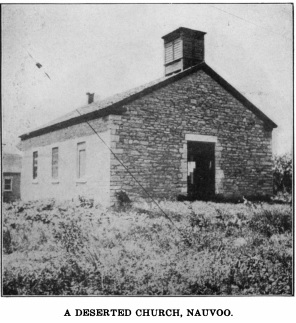
A DESERTED CHURCH, NAUVOO.

meantime keeps a watchful eye on the soap and comb, while
she makes pointed remarks about these people who go about
in autos; since she does not know them, they can't be re-
spectable; that their starting, point is known only to the
powers above and their destination is known orly to his
Satanic majesty below; and she concludes by saying that she
never cared for autos nohow nor the folks who ride in 'em.

Here is another example of the independence of this
unique place. I was the first to step up to the postmaster's
window. **You'll have to wait," said he, **Your's is a
special delivery and that's always so much trouble." I ac-
cepted his ultimatum and stood aside while the whole town
filed past. My mail must come last, because it was special
delivery.

Early in the 60 's a steamboat came down the Mississippi
carrying an opera company which stopped at each town.
Among this company was a young man of more than ordi-
nary talents. When they reached Nauvoo, he could not go
but stayed on for very love of the place. And he is still there,
singing bass in the little Catholic choir, leading a frugal life,
and wor^ig in his cozy old fashioned garden where he may
be heard at dusk, singing **The Last Eose of Summer." If
you should stop, he will come forward eagerly to greet you,
his fl^e old face alight with pleasure to meet one of his Mnd.
He will show you a portfolio filled with drawings made when
he was a boy in Cologne and later when he studied at Dussel-
dorf— drawings made with a raven's quill, for nothing else
was fine enough for his work; etchings of cathedrals of the
old world; minute, careful drawings of all the flowers man
knows, botanically as well as artistically correct — **My
flower garden on paper" as he so quaintly calls it. All these
he will show you, turning the pages with eager, trembling
hands. That over, he will lean back and tell stories of his
yoimg manhood, when he worked as frescoer in Germany.
Then he will show you his watch, a marvelous old timepiece,
which strikes the hours in a musical tinkle. Or perhaps he
will show you his only companion and housemate, a mongrel
cur, indescribably dear to his master.

And over and above all hovers the charm of the middle
west. The discordant strains of the calliope which float in-

land from a passing steamboat ; the expressive phrase of the
riverman which accompanies high water, '* There's a big
water comin' down:" all this breathes the spirit of the Mis-
sissippi, beautiful in its very ugliness — and there is one
American man of letters who would agree with me.
- Comment
- Reblog
-
Subscribe
Subscribed
Have a WordPress.com account? Log in now.


Leave a Reply